
Cultivating
Sustainable Futures
 News
News
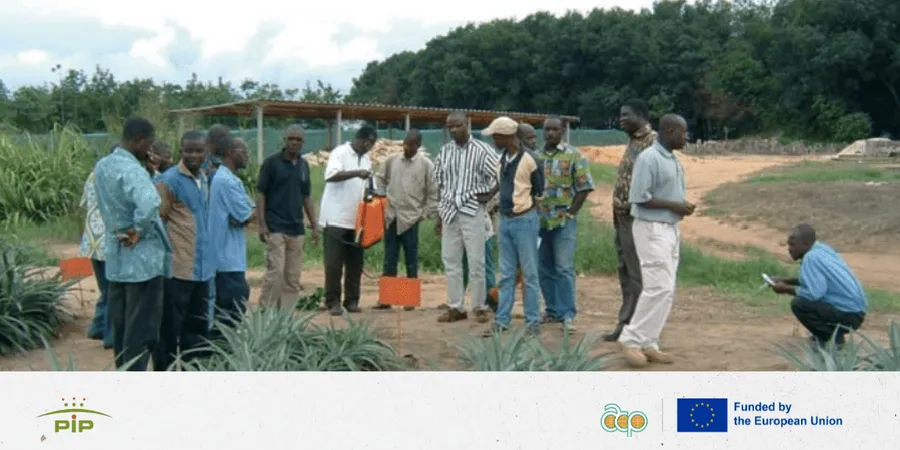
Flashback 2005 : “Training Knowledge without bounds”
Source PIP Magazine n°8, November 2005“Training is one of the main priorities of PIP in its capacity-building actions for companies and for the ACP horticultural network as a whole. To date, more than 700 people have participated in collective and in-company training sessions organised by the PIP Training Unit, and 130 consultants in several countries have received a training of trainers .“Knowledge should know no bounds,” declares Edward Ngenga, casting a glance over his ten-acre farm. This small-scale farmer from Kiseria – about 30 kilometres from Nairobi, Kenya – began EurepGAP-certified production in January 2005. His desire to increase his income by working for the export market led him to start growing green beans and mangetout peas for East African Growers (EAGA), one of the biggest Kenyan operators in the sector. This 62-year-old engineer – a latecomer to agriculture – did not wait long before dividing his land into plots and providing the necessary infrastructure: toilets, handwashing equipment, warehouse for stocking phytosanitary products, coal-fired cold storage, etc. He admits that he lacks experience in crop protection, and applies the East African Growers field adviser’s instructions to the letter for pesticide choice and amounts. “I’m only too pleased to learn,” he says, looking with satisfaction at the rain clouds waiting to empty themselves over his crops.Two pillars The training strategy developed by PIP rests on two pillars: training of trainers and collective training. Training of trainers consists in reinforcing the technical knowledge of local experts (agronomists, hygienists, etc.) by providing them with teaching methods. After training, workshop participants are therefore required to have gained solid technical knowledge of the key areas of food safety and crop protection, as well as the capacity to train the support and technical staff of local companies. Yannick Van Landeghem, farm supervisor for Lecofruit (Madagascar), received training of trainers in Dakar in October 2004: “The theoretical part of the course was presented in the form of lectures, and the practical part took place in the field, with a hands-on approach to the theory,” he explains. “The main role of the technical part was to provide tangible elements that would facilitate an understanding of the lectures, which examined issues seldom taught in study programmes. What I got most out of the seminar was the methodology they taught us; it has allowed me to pass on information and work methods effectively by adapting them to the small growers I work with.”To date, 130 people have received a training of trainers . Since 2004, most of them have been part of a pool of local providers/experts which the PIP relies on constantly to give collective training. These collective training sessions are intended for company managers (quality assurance and traceability managers, production managers, packhouse managers, small-grower managers, etc.) in order to prepare them to implement and ensure the consistency of food safety control systems. The topics dealt with during these sessions focus on the management of food safety procedures, European regulations, the safe use of pesticides, hygiene, tools for managing traceability and production, the identification of harmful organisms and crop protection, among others. Once the company managers have received a certain level of training, they are expected to use their new knowledge in the field by passing it on to the very roots of the company. This includes, for example, farm labourers, packhouse employees, small growers, etc.”The Pesticides Initiative Programme (PIP) was financed by the European Development Fund. The ACP Group of States and the European Commission entrusted responsibility for its implementation to COLEACP (today COLEAD).
 News
News
DO NOT WAIT TO REGISTER! Malawi-EU Investment Forum - 26-28 November 2024 - Lilongwe & Online
[maxbutton id="11" url="https://app.swapcard.com/event/1st-malawi-eu-investment-forum" text="REGISTER HERE" ]Closing of the registration: 20th November 2024The objective of the Malawi-EU Investment Forum (MEIF) is to mobilise sustainable investment in Malawi while enhancing Malawi-EU trade. The main goal is to showcase the economic opportunities and sustainable investment potential that exist in Malawi, fostering a dynamic environment conducive to mutual growth and collaboration.The forum will take place in Lilongwe, Malawi, from 26 to 28 November 2024 at the Bingu International Conference Centre, under the theme of 'Creating Sustainable Investment Opportunities: Strengthening EU-Malawi Economic Ties'.The MEIF, organised by the Government of Malawi, the Malawi Investment and Trade Centre, and the EU Delegation to Malawi presents a unique opportunity to establish links and create lasting partnerships between public and private project promoters and European investors and European Development Financial Institutions.The event will showcase key investment projects in three critical sectors for Malawi's identified as drivers of growth and sustainable development—namely agriculture, tourism, and energy. EU investors who are already operating in Malawi will also share their experiences and insights.As a registered participant, you will have the opportunity to network and explore exciting and mutually beneficial investment and trade opportunities as well as exchange valuable experiences.For more information and agenda updates, visit the Forum website here.
 News
News
AGRINFO Webinars: a gateway to EU regulatory insights for partner countries
As part of COLEAD's efforts to strengthen the agri-food sectors in low- and middle-income countries, the AGRINFO programme, funded by the European Union, has been organising a series of webinars to provide stakeholders with critical information on evolving EU regulations and standards. These webinars are essential tools for helping partner countries navigate the complex regulatory landscape and ensure their agricultural exports remain competitive in EU markets.The AGRINFO programme is designed to address the challenges posed by the EU Green Deal, the Farm to Fork strategy, and other EU regulatory changes that impact agricultural value chains. By delivering up-to-date, accessible, and actionable information, AGRINFO ensures that stakeholders—from professional organisations to national authorities—can effectively respond to these new requirements. The programme's ultimate goal is to support sustainability, food safety, and market access, contributing to poverty reduction and food security in EU partner countries.Diverse geographic coverageThe webinars organised under the AGRINFO programme have reached a wide range of countries across different regions, demonstrating the programme's broad geographical scope. Countries involved in these webinars include:Sri LankaSouth AfricaPhilippinesIndiaColombiaBrazilTanzaniaCôte d'IvoireEgyptLebanonDominican RepublicMadagascarEach of these webinars has been tailored to meet the specific needs of the country or region, addressing critical topics such as organic regulations, novel foods, oil standards, and more. The webinars have been organised in collaboration with local embassies, export promotion agencies, European Union Delegations and other stakeholders, ensuring that the information is relevant and accessible to the target audiences.Engaging stakeholders for greater impactThe AGRINFO webinars play a crucial role in enhancing the capacity of national authorities, business membership organisations, and agri-food companies to comply with EU regulations. By offering insights into the latest regulations and standards, the programme equips stakeholders to better understand the implications of EU policies and leverage opportunities for market access.By reaching countries in Africa, Asia, the Caribbean and Latin America, the AGRINFO programme exemplifies COLEAD's commitment to supporting sustainable, inclusive and resilient farming agrifood systems in low- and middle-income countries.The AGRINFO programme is implemented by COLEAD and funded by the European Union (EU). This communication has been produced with the financial support of the EU. Its contents are the sole responsibility of COLEAD and can under no circumstances be regarded as reflecting the position of the EU.
 News
News
Strengthening university-business partnerships in Africa to scale up capacity building for innovation
The Regional Universities Forum for Capacity Building in Agriculture (RUFORUM), established in 2004, is a consortium of 170 universities from 40 African countries. Its secretariat is based at Makerere University in Kampala, Uganda. RUFORUM supports the African Union in the implementation of the African Union Strategy on Science, Technology and Innovation. Learn more: https://www.ruforum.org/The collaboration between DeSIRA LIFT Area 2, implemented by COLEAD in partnership with the Natural Resources Institute (NRI), and RUFORUM has been significantly strengthened. This partnership focuses on a comprehensive review of the national science, technology and innovation landscape with the aim of translating university research and innovation into viable businesses. The primary objective is to generate knowledge to support agribusiness incubation and entrepreneurship within African universities, targeting both faculty and students as entrepreneurs, innovators and job creators.Key activities include identifying successful business cases linked to university research outputs or graduates. This will involve documenting lessons learned on capacity strengthening and exploring potential leverage points for university-enterprise partnerships to scale up innovation. This work is crucial for scaling up innovation and strengthening the links between universities and business, and more globally between academia and the private sector. It also contributes to the ongoing study on financing innovation. Preliminary findings were discussed at the 2nd RUFORUM Triennial Conference on "Operationalising Higher Agricultural Education and Research Ecosystems for Innovation, Industrialisation and Economic Development in Africa: A Call for Action", held in Namibia in August 2024.This initiative is in line with COLEAD's broader objectives, which focus on enhancing the capacity of universities to foster entrepreneurship and innovation. It aims to create a robust ecosystem where academic research can directly contribute to economic development and job creation in the agribusiness sector.In addition, two other areas of work are being developed with RUFORUM: co-certification mechanisms for vocational training of agricultural innovation facilitators, and an overview of existing e-learning platforms offering self-paced training modules on innovation management and facilitation. These modules will be used by professionals involved in agricultural innovation projects in Africa.Strengthening partnerships between universities and businesses in Africa is essential for scaling up skills development and fostering innovation. By aligning educational outcomes with industry needs, fostering collaborative research and addressing existing challenges, these partnerships can make a significant contribution to the continent's economic development. As Africa continues to grow and develop, university-industry collaboration will play a key role in shaping a prosperous and innovative future.DeSIRA-LIFT (June 2021 – May 2025) is the result of close collaboration between Agrinatura (European Alliance on Agricultural Knowledge for Development), the European Forum on Agricultural Research for Development (EFARD) and the European Commission’s Directorate-General for International Partnerships (DG INTPA).
 News
News
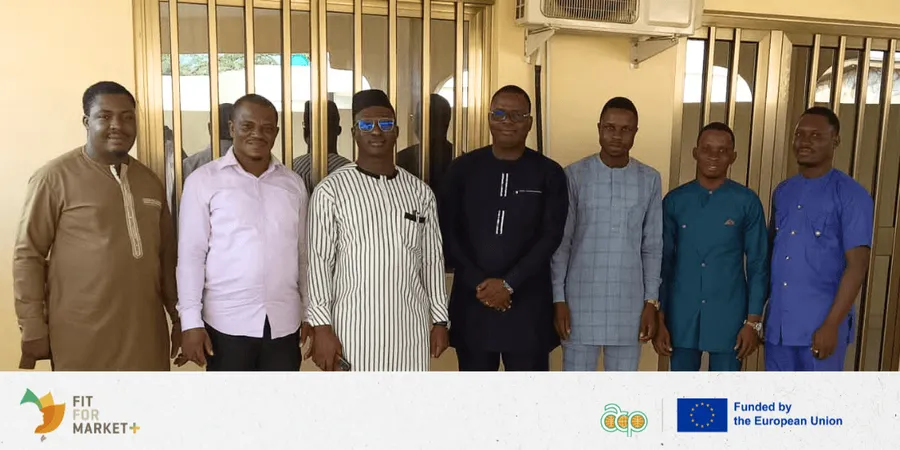
West Africa: strategic support for the regional association AOCTAH
The Association Ouest Africaine du Commerce Transfrontalier des Produits Alimentaires, Agro-sylvo-pastoraux et Halieutiques (AOCTAH), based in Togo, is an umbrella association of private socio-professional organisations in the agro-sylvo-pastoral and fisheries sectors whose members are involved in the marketing of food or agro-sylvo-pastoral and fisheries products in or between ECOWAS countries and CILSS.AOCTAH has a multifaceted mission: (i) to promote solidarity in food and nutrition security and trade in the CILSS and ECOWAS area; (ii) to initiate, lead and manage actions related to cross-border trade in food, agro-sylvo-pastoral and fishery products; and (iii) to carry out trade facilitation activities in West Africa by collecting data on cross-border flows and establishing trade information and border assistance offices.AOCTAH has around one hundred members, 50% of which are active in the fruit and vegetable sector. Each member represents thousands of producers. As part of the Fit For Market Plus (FFM+) programme, COLEAD has recently supported AOCTAH in developing a strategic development plan for the coming years (2025/2029). A SWOT (Strengths, Weaknesses, Opportunities, Threats) analysis of the organisation was carried out, focusing on internal factors and the global environment in which it operates. This analysis enabled us to identify and prioritise the areas to strengthen in order to fully implement the mission of the association.This activity is supported by the Fit For Market Plus (FFM+) programme, implemented by COLEAD within the Framework of Development Cooperation between the Organisation of African, Caribbean and Pacific States (OACPS) and the European Union. This publication receives financial support from the European Union and the OACPS. The content of this publication is the sole responsibility of COLEAD and can in no way be taken to reflect the views of the European Union or the OACPS.
 News
News
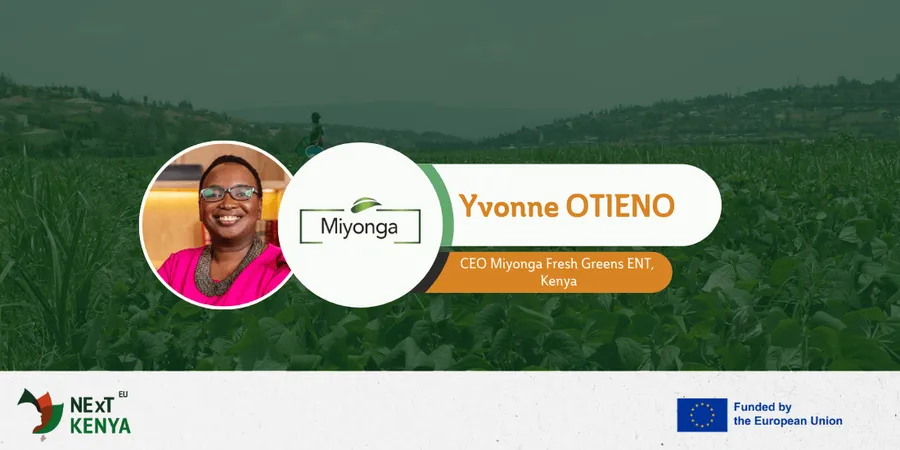
Yvonne Otieno inspires us and you?
Yvonne Otieno, the dynamic CEO of Miyonga Fresh Greens ENT, has dedicated her career to reducing food waste and empowering smallholder farmers through sustainable agricultural practices. With a background as a journalist, Yvonne transitioned her communication skills into driving social change, accumulating over 16 years of experience in international development and community empowerment.Miyonga Fresh Greens ENT, established in 2015, emerged from Yvonne’s vision to address two pressing issues: the significant waste of farm produce and the growing demand for fresh, quality produce. Starting as a small 10-acre farm in Machakos County, Kenya, Miyonga has expanded into a leading exporter of fresh fruits, dried products, and powders to international markets. The company now collaborates with a network of over 5,000 smallholder farmers across East Africa, offering training in sustainable farming practices, crop variety selection, and achieving certifications like GlobalGAP.Innovatively tackling food waste, Miyonga processes surplus fruits into dried products and powders, adding value and ensuring that farmers earn more from their produce. Yvonne's impactful "Wheeling Fruits" program, a mobile fruit processor, allows Miyonga to reduce seasonal waste and boost productivity by processing fruits directly from farms in various regions.Under Yvonne's leadership, Miyonga has not only become a profitable venture but also a force for positive social impact, creating over 7,500 jobs, supporting 30,000 farmers, and improving countless lives. Recognized for its commitment to sustainability, gender equality, and innovation, Miyonga Fresh Greens ENT has received numerous awards, including the Gender in Innovation in Agriculture Award and the Social Impact Award at Nairobi Innovation Week.Yvonne Otieno's journey with Miyonga is a testament to how a strong vision, dedication to community empowerment, and innovative thinking can create lasting change in Africa's agricultural landscape.Miyonga Fresh Greens ENT has been partner beneficiary of the NExT Kenya programme. You can find more information on the company and Yvonne Otieno though the COLEAD Agrinnovators platform. This activity is supported by the NExT Kenya (New Export Trade) programme, established in collaboration with the EU Delegation in Nairobi and Kenyan stakeholders. This publication receives financial support from the European Union. The content of this publication is the sole responsibility of COLEAD and can in no way be taken to reflect the views of the European Union.
 News
News
Colombia: 100 private sector representatives mobilised to better understand EU regulatory changes
On 24 September, COLEAD, in collaboration with PROCOLOMBIA, a government agency linked to the Colombian Ministry of Trade, Industry and Tourism, presented the AGRINFO programme to around 100 participants from the Colombian agrifood sector. These representatives of exporting companies in the agricultural sector were given full details of this EU-funded programme, which provides partner beneficiaries with continuously updated information on EU regulatory changes affecting the agricultural sector in partner countries. This programme and its freely available tools are essential for any exporter of agricultural products to the EU. They enable them to keep abreast of and anticipate changes that are likely to affect their business and day-to-day operations.As a reminder, the AGRINFO programme was set up to support the EU’s partner countries (listed as low-income, lower-middle income and upper-middle-income economies in the Development Assistance Committee List of ODA Recipients of the Organisation for Economic Co-operation and Development (OECD)), understand and anticipate the impact of changing EU regulations on their agrifood exports to the European market. In practice, AGRINFO provides EU trading partners with clear summaries of the “what, why and when” of recent and forthcoming changes, as well as the actions needed to adapt to new EU regulations.Want to understand in two minutes how AGRINFO can help you? Then click here.The video is available in English, French and Spanish.The AGRINFO programme is implemented by COLEAD and funded by the European Union (EU). This communication has been produced with the financial support of the EU. Its contents are the sole responsibility of COLEAD and can under no circumstances be regarded as reflecting the position of the EU.
 News
News
Flashback 2005 “ACP Task Force: promoting dialogue between the public sector and private operators”
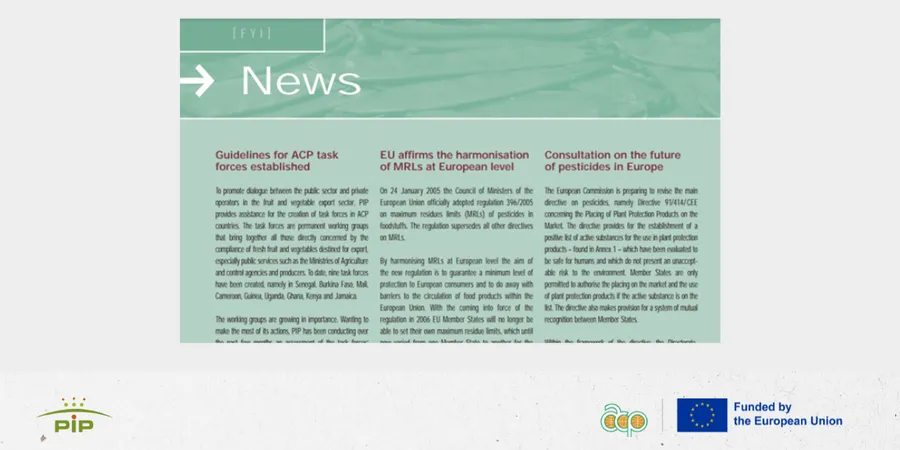
“To promote dialogue between the public sector and private operators in the fruit and vegetable export sector, PIP provides assistance for the creation of task forces in ACP countries. The task forces are permanent working groups that bring together all those directly concerned by the compliance of fresh fruit and vegetables destined for export, especially public services such as the Ministries of Agriculture and control agencies and producers.To date, nine task forces have been created, namely in Senegal, Burkina Faso, Mali, Cameroon, Guinea, Uganda, Ghana, Kenya and Jamaica. The working groups are growing in importance. Wanting to make the most of its actions, PIP has been conducting over the past few months an assessment of the task forces’ experiences and the problems they encounter. This work culminated in a series of guidelines for the creation and management of a task force which covers a number of topics such as the composition of a task force, the issues it should address as well as operational and intervention issues. The guidelines are not binding and should be adapted to the specific context of each ACP country. The ACP Task Force guidelines are available in French and English on the PIP website”Source : PIP Magazine April 2005The Pesticides Initiative Programme (PIP) was financed by the European Development Fund. The ACP Group of States and the European Commission entrusted responsibility for its implementation to COLEACP (today COLEAD).
 News
News
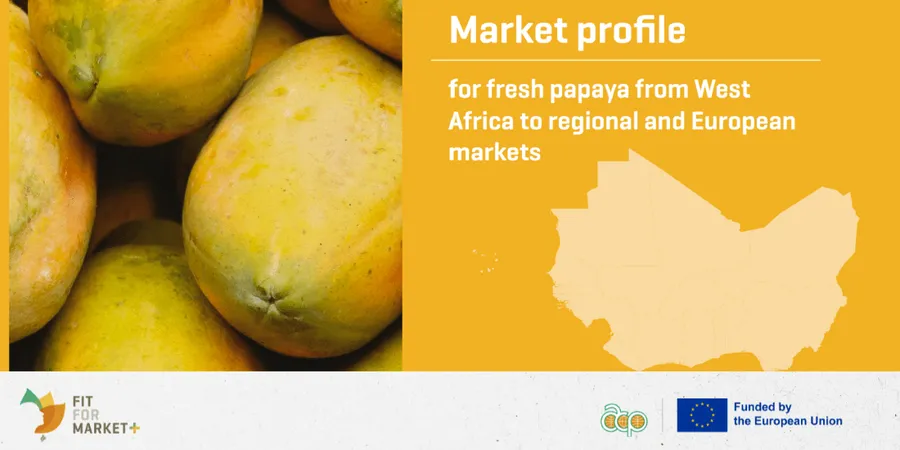
New papaya market study
We are pleased to announce the publication of a new market study entitled "Market Profile for Fresh Papaya from West Africa to Regional and European Markets", which is now available in the COLEAD e-library. This comprehensive study, produced by COLEAD's Market Insights department through the FFM+ programme, provides valuable analysis and insights into papaya production, export trends and market dynamics, with a particular focus on West African producers.Key highlights of the study includeGlobal production overview: Detailed data on global papaya production, highlighting the role of West Africa, including countries such as Nigeria, Ghana and Senegal.Export Logistics: Analysis of the logistics affecting papaya exports, such as the impact of air and ocean freight on pricing and market access.European market trends: An exploration of consumer demand in key European markets (France, Germany, UK) and insights into the competitive landscape with major producers such as Brazil.Sustainability and certification: A look at the growing importance of certifications such as GLOBALG.A.P., Fair Trade and organic practices in meeting the requirements of European importers.Opportunities and challenges: Strategic opportunities for papaya growers to expand their market presence, taking into account both regional consumption patterns and export potential.This study is part of the Market Insights Department's ongoing efforts under FFM + to provide strategic information and market intelligence and business development services to value chain stakeholders. It aims to support decision making and facilitate access to new market opportunities, directly contributing to COLEAD's mission of strengthening value chains and facilitating market access.Access the full report hereFor more information about the Market Insights department and other resources available through COLEAD's programmes, please visit our e-library or contact the team directly. Let's continue to work together to use these insights and contribute to the growth of sustainable agri-food systems.This activity is supported by the Fit For Market Plus (FFM+) programme, implemented by COLEAD within the Framework of Development Cooperation between the Organisation of African, Caribbean and Pacific States (OACPS) and the European Union. This publication receives financial support from the European Union and the OACPS. The content of this publication is the sole responsibility of COLEAD and can in no way be taken to reflect the views of the European Union or the OACPS.
 News
News
The Global Coalition of Fresh Produce publishes survey results
The Global Coalition of Fresh Produce has published the final results of its second survey into costs and revenues in the global fruit and vegetable industry, conducted in the spring of 2024. “We conducted this survey as a follow-up to the survey conducted by the Coalition in 2023, when producers and traders the world over were facing unprecedented cost hikes,” said Ron Lemaire, chairman of the Coalition and president of the Canadian Produce Marketing Association. “The aim of this new survey was to understand how the situation has evolved over the past year.” According to the Coalition’s new report, the industry is continuing to grapple with substantial cost increases across various inputs, despite some moderation of the rises experienced during and immediately after the Covid-19 pandemic.These include construction materials (up 56 per cent year-on-year), fertilisers (up 33 per cent), fuel (up 31 per cent), machinery (up 30 per cent), and shipping services (up 28 per cent).A majority of respondents managed to increase their average selling prices compared to last year, the survey found, although, most remain unable to fully offset rising costs for various reasons.These reasons include intense price competition in the fresh produce market, limited consumer purchasing power, and a lack of bargaining power with buyers.Also, some 76 per cent of operators are operating at a break even or profit, compared to 81 per cent in 2023, the survey revealed.“What is worrying,” noted Lemaire, “is that financial strain has affected operators’ ability to invest in critical areas like capital equipment, innovation, and expansion, which are all essential for long-term sustainability.”Looking ahead, the outlook remains “daunting”, the Coalition said, with ongoing geopolitical tensions, climate change impacts, and persistent inflationary pressures expected to prolong cost escalations.As a result, a substantial proportion of respondents fear for the future economic viability of their operations, with nearly 70 per cent considering the possibility of closure within the next two to three years.On the positive side, Lemaire highlighted that “there is optimism within the market, and the industry has shown great resilience in adapting to immediate challenges”.“However,” he added, “the path to sustainable recovery and growth hinges on addressing the systemic issues driving cost increases, and ensuring adequate support for long-term investment and innovation.”The final report is available on the Global Coalition of Fresh Produce website here.Source of the article : Fruitnet from GCFP press releaseCOLEAD is a member of the GCFP coalition and participated in the survey by surveying its network as part of the FFM+ programme. It should be noted that almost 50% of the feedback from the global survey came from Africa. This activity is supported by the Fit For Market Plus (FFM+) programme, implemented by COLEAD within the Framework of Development Cooperation between the Organisation of African, Caribbean and Pacific States (OACPS) and the European Union. This publication receives financial support from the European Union and the OACPS. The content of this publication is the sole responsibility of COLEAD and can in no way be taken to reflect the views of the European Union or the OACPS.
 News
News
The R-SAT tool at the service of the IPPC assessment system
COLEAD, through the FFM+ programme and as part of its partnership with the IPPC, has recently developed a one-month training session (29 July to 28 August) on its R-SAT tool to meet the specific needs of the IPPC PCE (Phytosanitary Capacity Evaluation). This is in the context of sharing best practices, the successful implementation of RSAT in the target region and the desire to harmonise the capacity building strategy for PCE facilitators and National Plant Protection Organisation (NPPO) coordinators.PCE facilitators and NPPO coordinators from 11 target countries benefiting from the project to strengthen capacity and governance in food and plant health control (CP/GLO/949/EC) were invited to participate in this training. 8 countries actively participated: Eswatini, Kenya, Malawi, Uganda, Zambia, Zimbabwe, Egypt and Rwanda.This highly interactive 4-week training session also provided an opportunity to prepare for the IPPC-COLEAD workshop to be held in Rome from 7 to 11 October. It should be noted that the Rome session will also include a special half-day session on gender mainstreaming in IPPC-COLEAD activities, in collaboration with the FAO Gender Unit.Although the outcomes will not be limited to the exchange of best practices between the different stakeholders, they will undoubtedly lead to the identification of further gaps in the implementation of SPS measures, outputs, new training materials and new project definitions to better support NPPOs and PCE/RSAT facilitators in line with the COLEAD SPS strategy in African Caribbean and Pacific countries.This activity is supported by the Fit For Market Plus (FFM+) programme, implemented by COLEAD within the Framework of Development Cooperation between the Organisation of African, Caribbean and Pacific States (OACPS) and the European Union. This publication receives financial support from the European Union and the OACPS. The content of this publication is the sole responsibility of COLEAD and can in no way be taken to reflect the views of the European Union or the OACPS.
 News
News
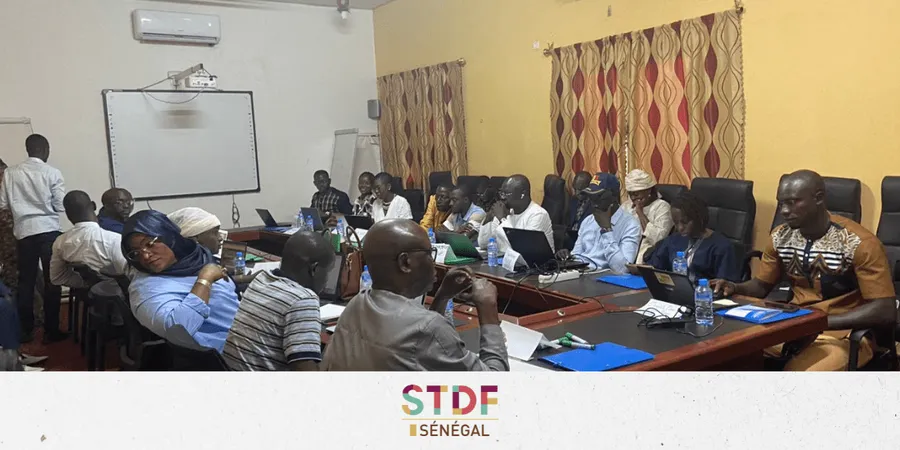
Senegal strengthens its capacity in pest risk analysis
A training course on pest risk analysis (PRA) began in Dakar on 9 September at the plant health training centre run by the Plant Protection Directorate (DPV).This capacity building is part of the STDF/PG/946 Senegal project implemented by COLEAD and is aimed at experts from the Technical Working Group on Pest Risk Analysis. The objectives are to support the setting up of a technical and interdisciplinary working group on pest risk analysis and to develop/run a training course on the stages and conduct of a PRA, in accordance with the standards in force and the tools available (international standards for phytosanitary measures -NIMP, EPPO, COLEAD, CABI, etc.).This new training course enabled the group to: understand the principles of PRA, know where to collect the necessary data, identify phytosanitary risks (list pests, analyse introduction and propagation routes, etc.), assess phytosanitary risks and determine risk management measures (including contingency plans and communication).Following the training, the working group was asked to carry out eight PRAs, again as part of the STDF programme, namely 4 PRAs on a commodity chain/pest export pairing and 4 PRAs on a commodity chain/pest import pairing.‘Senegal's development will come from its young people’, said Mr Ngom, Director of the Plant Protection Directorate, at the opening of the COLEAD training course under the STDF programme.Discover the opening remarks from Mr. NGOM, Director of the DPV, on the first day of training, highlighting the importance of youth