
Key points
This news update is a review of changes that were made in 2025.
European Union (EU) maximum residue levels (MRLs) were changed for 38 plant protection products (PPPs) in 2025, compared with 78 in 2024. These changes include cases where MRLs for certain foods have been raised or lowered.
In Great Britain (GB) maximum residue level (MRL) changes concerned 42 plant protection products (PPPs) in 2025, compared with 33 in 2024. Note that EU MRLs still apply in Northern Ireland (GB covers only England, Scotland and Wales).
How will ACP producers/exporters be affected?
In export crops, meeting the MRLs of the destination market is critical to prevent interception and destruction of merchandise at the border. ACP growers and exporters need to remain up-to-date with regulatory changes to ensure they remain aligned.
What should ACP producers/exporters do now?
For each substance and crop concerned, the Good Agricultural Practices (GAPs) in place need to be verified and possibly adapted to ensure compliance with new MRLs. The GAPs include dose rate, number of applications, and pre-harvest interval. In some cases, adaptations to the GAPs will allow the new MRLs to be met. However, in many cases, especially where the level is reduced to the Limit of Determination (LoD), it may not be possible to meet the new MRL, and growers will have to look for alternative crop protection solutions.
If you have any major concerns about these changes, and fear that you will be left without an effective and locally available alternative, please contact COLEAD at: network@colead.link.
If you require more frequent updates on EU MRL changes, we invite you to visit our AGRINFO website and subscribe to the newsletter on EU regulations.
Our news is a quarterly update designed to inform you of any changes introduced during the preceding five months. If you require more frequent updates on EU MRL changes, we recommend that you visit our AGRINFO website and subscribe to the bi-monthly newsletter on EU regulations.
ACP countries potentially impacted by changes of EU and GB PPP approvals during the period January-May 2026
COLEAD has compiled a dashboard presenting registered products containing the active substances for which the approval is expiring or withdrawn in the EU and in GB and their respective conditions of use in ACP countries. This aims to outline the ACP countries where these approval changes might have repercussions for export. It is based on information extracted from the latest national lists of registered plant protection products made available by 40 ACP countries (list available here).
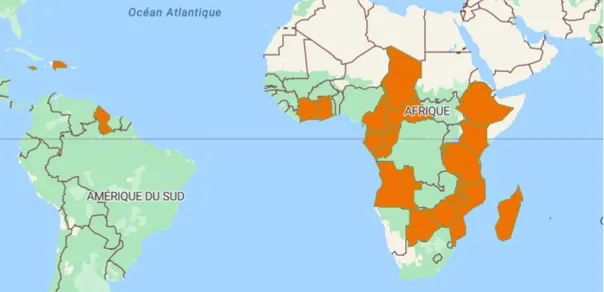
Figure 1: Map of the potentially impacted ACP countries following the changes of approvals in the EU and GB in 2026
COLEAD is making all effort to provide you with relevant and updated information. If your country is not included in the 40 countries included in our review, we highly recommend reaching out to your national authorities to check which products might be affected by these changes.
Key changes of approval in the EU during the period January-May 2026
The EC has recently published changes to 34 plant protection product (PPP) approvals within the EU, including changes to 21 key active substances. In this News, ‘key active substances’ refers to those used/registered in one or more ACP countries on horticultural crops that are frequently exported regionally or internationally.
1 Expiration of approval
The active substance methoxyfenozide expired on 03 March 2026. Through Commission Implementing Regulation 2026/1154, the substance has been removed from the list of active substances approved under Regulation (EC) No 1107/2009.
Methoxyfenozide is an insecticide used to control various insects including moths and butterflies on a large range of horticultural crops. According to available registrations, the substance is currently present in 36 plant protection products (PPPs) across 11 ACP countries, indicating a potentially significant impact for some export-oriented horticultural sectors.
4 Renewals of approvals for key active substances:
- Maltodextrin: renewal of approval as low-risk active substance (Expiry date: 03 March 2041)
- Pyrimethanil: renewal of approval (Expiry date: 30 April 2041)
- Spinosad: renewal of approval (Expiry date: 01 April 2041)
- Paraffin oil (CAS 8042-47-5): renewal of approval (Expiry date: 30 June 2041)
Approval periods for the following 15 key substances have been extended (new expiry dates):
- Boscalid (Expiry date: 31 March 2028)
- Dodine (Expiry date: 30 June 2028)
- Esfenvalerate (Expiry date: 30 November 2029)
- Eugenol (Expiry date: 15 April 2028)
- Fenpyroximate (Expiry date: 31 January 2028)
- Fluazinam (Expiry date: 30 November 2027)
- Fluopyram (Expiry date: 15 June 2028)
- Geraniol (Expiry date: 15 April 2028)
- Malathion (Expiry date: 15 July 2028)
- Proquinazid (Expiry date: 31 December 2027)
- Pyrethrins (Expiry date: 15 April 2028)
- Pyridaben (Expiry date: 31 January 2030)
- Spiroxamine (Expiry date: 30 November 2029)
- Sulphur (Expiry date: 31 July 2027)
- Thymol (Expiry date: 15 April 2028)
While COLEAD makes every effort to provide comprehensive information about EU and GB PPP regulatory changes, it is possible that some PPPs or crops relevant to you are not included in our list of key substances/crops. We recommend that you review the following section, which gives details on all approval changes since the beginning of 2026, to check for any others that could affect you. If you see any PPP that you use on crops for export to the EU or GB in the lists below, we recommend that you check the regulation itself using the link provided.
All PPP approval changes in the EU introduced in 2026
Table 1 shows all changes to PPP approvals introduced in the EU since the beginning of
Key changes of approval in GB during the period January-May 20262026.
Since the beginning of 2026, approval status have been updated for 10 plant protection product (PPP) approvals within GB, of which 3 are considered key for ACP horticulture (pyridaben, dazomet and metaldehyde).
3 Withdrawals of key active substances
The Health and Safety Executive (HSE) has decided to withdraw the approval for use in GB for 3 key active substances for ACP horticulture sector.
Pyridaben is an insecticide and acaricide effective against thrips, mites, aphids and leafhoppers, and used on a broad range of fruit and vegetable crops. Pyridaben is used in 35 Plant protection products (PPPs) registered in 10 ACP countries. The expiration date of the approval for its use in GB is 30 April 2026.
Dazomet is a broad-spectrum pre-plant soil fumigant. Four ACP countries have registrations to at least one PPP containing dazomet. The approval for use in GB expired on 31 May 2026.
Metaldehyde is a molluscicide bait for controlling slugs and snails on various fruits and vegetables crops. It is present in 51 PPPs registered across 19 ACP countries. The approval of the active substance metaldehyde in GB expired on 31 May 2026.
All PPP approval changes in GB since the beginning of 2026
Table 2 shows all changes to PPP approvals introduced in GB since the beginning of 2026.
Proposed future approval changes - WTO notifications
All draft regulations must be notified either to the WTO Sanitary and Phytosanitary Committee (SPS) or Technical Barriers Committee (TBT) for a commenting period of 60 days before they are adopted. This provides an important opportunity for countries to comment on the proposed changes, and to seek an amendment if a change is likely to have a significant impact on exports. To provide feedback stakeholders should contact their national WTO contact point .
During the period January-May, nor the EC, nor HSE have notified the WTO of future approval status changes that could affect exports to the EU or to GB.
If you require additional information or face particular problems as a result of these changes, please contact COLEAD at: network@colead.link .
References
Lewis, K.A., Tzilivakis, J., Warner, D. and Green, A. (2016). An international database for pesticide risk assessments and management. Human and Ecological Risk Assessment: An International Journal, 22(4): 1050-1064. DOI: 10.1080/10807039.2015.1133242